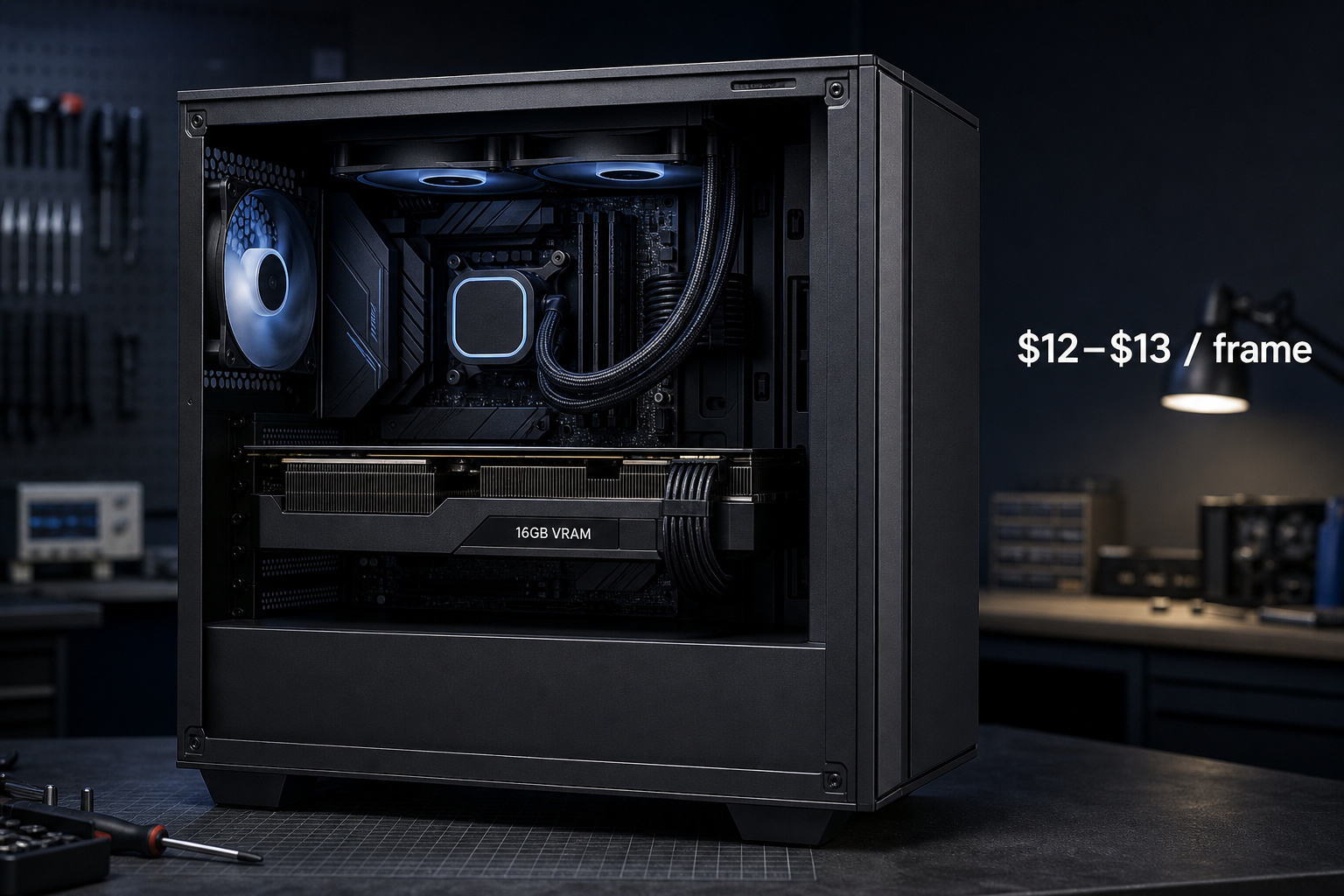
The best 1440p gaming PC cost per frame in 2026 comes from a mid-range build near $1,250–$1,500: grab an AMD RX 9070 or RX 9070 XT for raw value, or an RTX 5070 / 5070 Ti if you want ray tracing and DLSS. That lands around $12–$13 per native frame at 1440p Ultra for the whole tower, or roughly $5 per frame at the graphics card alone. Spend less and a cheaper card misses your FPS target; spend more and you pay the steepest premium per frame in the stack.
One correction before the numbers: this isn't a forecast. The cards that decide it (NVIDIA's RTX 50-series, AMD's RX 9000-series (RDNA 4), and Intel's Arc B-series) already ship with measured benchmarks and real street prices. Ignore older chatter about an "RX 8000-series," an "RTX 5070 Super," or a "Ryzen 8000X3D" lineup; the shipping hardware replaced that guesswork. And treat cost per frame as a comparison lens, not a verdict: the cheapest per-frame figure is frequently the wrong buy.
What cost per frame actually measures
Cost per frame divides a part's price by its average FPS in a game suite: lower is better value. It's the standard way reviewers rank price-to-performance, and it comes in two flavors that you should never mix up.
Cost per frame (CPF): part price ÷ average 1440p Ultra FPS. GPU-only CPF uses just the graphics card price: the cleanest card-to-card comparison. Whole-system CPF uses the total build price, so the numbers run 2–3× higher because they carry the CPU, board, RAM, storage, and PSU.
Two rules keep the math honest. First, count native frames only. DLSS 4 and FSR 4 frame generation inflate the displayed FPS without improving input latency, so folding generated frames into the divisor makes a card look artificially cheap and breaks every comparison. Second, price on the street, not the sticker. Heading into 2026, GPU and DRAM prices ran hot from memory spikes and tariff pressure: real retail sits roughly 10–30% above MSRP. Tom's Hardware logged the RX 9070 near $630, the RTX 5070 at $660–$670, and the RX 9070 XT around $760 in mid-2026, all well above their $550–$600 launch prices. Build your budget off those, not the launch figures.
1440p Gaming PC: Cost Per Frame in 2026
Read the metric in the right order and it stops misleading you: fix the FPS target before you rank price-to-performance, then take the lowest per-frame figure among the cards that actually clear it. For a 1440p Ultra tower that target is 100+ FPS without upscaling — a bar that removes the cheapest per-frame options from contention and leaves a shorter shortlist than the raw ranking implies.
With the target set, the number becomes a tool you can run on any listing yourself: divide the price you'd actually pay by that part's 1440p Ultra average, then compare only the parts that made your cut. Run it on the finished tower as well as the card, and you'll catch the builds that win on paper but miss the frames you came for.
The 2026 value picks at a glance
Match your need to a card and a build cost. The mid-range wins because cost per frame gets worse in both directions: budget cards water down the whole-system number, and flagships always charge the most per frame.
| Buyer need | Recommended GPU | Approx. build cost | Why it wins |
|---|---|---|---|
| Tightest budget | Intel Arc B580 or RX 9060 XT 16GB | ~$1,000 | Lowest entry price; 12–16GB VRAM clears the 1440p floor |
| Best overall value | RX 9070 | ~$1,300 | ~104 FPS Ultra at ~$12–13 per system frame |
| Best for 144Hz | RX 9070 XT | ~$1,450 | ~116.5 FPS, near 5070 Ti raster for less |
| Best for ray tracing / DLSS | RTX 5070 / 5070 Ti | Under ~$1,750 | Stronger RT and broadest DLSS 4 support |
| Avoid for 1440p value | RTX 5080 / 5090 | : | Worst cost per frame in the stack |
GPU-only cost per frame
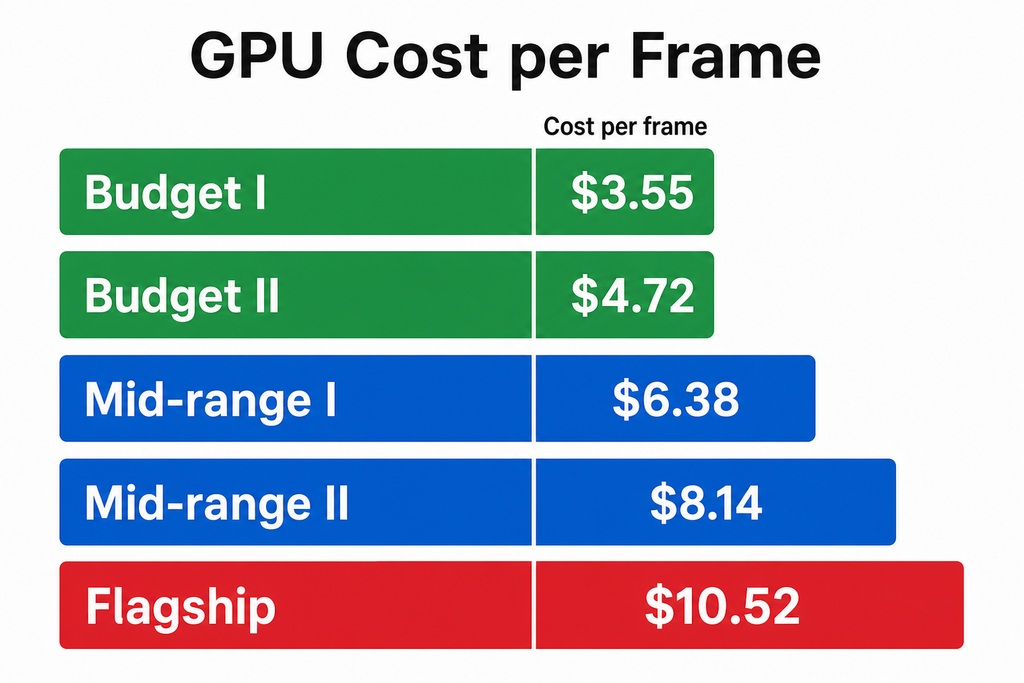
At the card level, budget silicon posts the lowest cost per frame, but that single number hides whether the card actually hits your target. FPS figures below track Tom's Hardware's 2026 GPU hierarchy at 1440p Ultra, native rasterization: no frame generation.
| GPU | MSRP | Street (mid-2026) | Avg 1440p Ultra FPS | Cost/frame (MSRP) |
|---|---|---|---|---|
| Intel Arc B580 12GB | ~$249 | ~$250 | ~70 | ~$3.55 |
| RX 9060 XT 16GB | ~$350 | ~$350 | ~67 | ~$5.20 |
| RX 9070 XT | ~$600 | ~$760 | ~116.5 | ~$5.15 |
| RX 9070 | ~$550 | ~$630 | ~104 | ~$5.29 |
| RTX 5060 Ti 16GB | ~$429 | ~$430 | ~80 | ~$5.36 |
| RTX 5070 | ~$550 | ~$660–670 | ~96 | ~$5.71 |
| RTX 5070 Ti | ~$750 | ~$750 | ~117 | ~$6.42 |
| RTX 5080 | ~$1,000 | ~$1,000 | ~128 | ~$7.79 |
| RTX 5090 | ~$1,999 | ~$1,999 | ~190 | ~$10.52 |
The Arc B580's ~$3.55 per frame looks unbeatable, and on the card alone it is. But ~70 FPS means Medium/High settings in demanding titles, and a $249 card barely dents a $1,000 tower: the rest of the parts dominate the total. Among cards that clear 100 FPS Ultra, the RX 9070 XT posts the best MSRP cost per frame at ~$5.15, with the RX 9070 right behind at ~$5.29. The RTX 5070's ~$5.71 reflects its ~96 FPS raster, about 13% behind the RX 9070 in TechSpot's 23-game 1440p comparison. Flagships climb from there: $7.79 on the 5080, $10.52 on the 5090.
Whole-system cost per frame by tier
The number your wallet sees runs $11–$19 per frame depending on tier, and the mid-range sits at the bottom of that curve. These builds pair each GPU with a matching CPU and 32GB DDR5; the FPS figures assume the GPU isn't held back at GPU-bound 1440p.
| Tier | Key parts (GPU + CPU) | Total build | Avg 1440p Ultra FPS | System cost/frame |
|---|---|---|---|---|
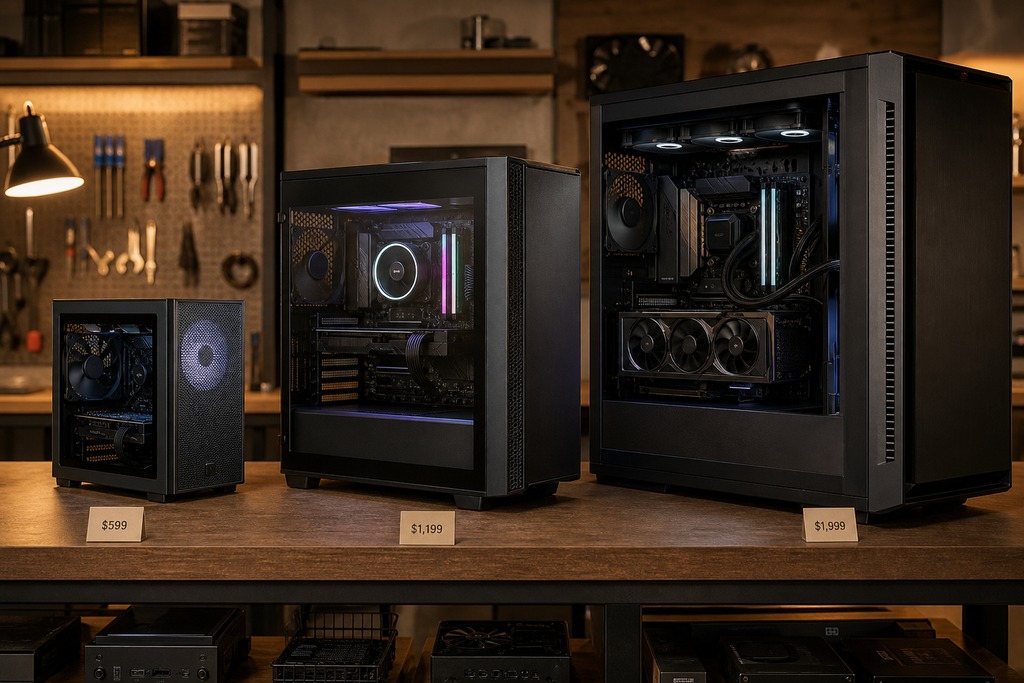
| Budget (Entry-Level) | Arc B580 / RX 9060 XT + Ryzen 5 | ~$850–1,050 | ~67–75 | ~$11–15.70 |
| Mid-Range AMD (best value) | RX 9070 + Ryzen 5/7 | ~$1,250–1,400 | ~104 | ~$12–13.50 |
| Performance sweet spot | RX 9070 XT + Ryzen 7 | ~$1,400–1,550 | ~116.5 | ~$12–13.30 |
| Mid-Range NVIDIA | RTX 5070 + Ryzen 5/7 | ~$1,300–1,400 | ~96 | ~$13.50–14.50 |
| Premium NVIDIA | RTX 5070 Ti + Ryzen 7 | ~$1,650–1,850 | ~117 | ~$14.10–15.80 |
| Enthusiast (High-End) | RTX 5080 + Ryzen 7 9800X3D | ~$2,100–2,400 | ~128 | ~$16.40–18.80 |
Aim for about $13 per native 1440p frame for a complete PC. Anything near $12 is excellent; past $16 means you're paying a premium for ray tracing, NVIDIA features, aesthetics, or CPU headroom you won't use at 1440p. Notice the Entry-Level tier's per-frame number can rival the mid-range at the low end: but it buys 67–75 FPS, not 100+, so you're saving money to accept a lesser experience.
Intel Arc B580: the budget floor
Intel's Arc B580 owns the cheapest single cost-per-frame figure at ~$3.55 (~$249, ~70 FPS), and its 12GB of VRAM clears the 1440p minimum. Treat it as the entry ticket, not a high-refresh card.
Pros:
- Lowest GPU cost per frame in the market (~$3.55)
- 12GB VRAM meets the 2026 1440p floor
- ~$249 MSRP, the cheapest way into 1440p
Cons:
- ~70 FPS Ultra means settings tuning in demanding AAA titles
- Driver overhead can cost frames on older CPUs
- A cheap card barely lowers the whole-system total
Verdict: Best for the tightest budget where 60–75 FPS at High settings is acceptable.
AMD RX 9060 XT 16GB: budget with headroom
The RX 9060 XT 16GB trades a hair of raw value for 16GB of VRAM at ~$350 and ~$5.20 per frame. Tom's Hardware measures ~67 FPS at 1440p Ultra: entry-level pace, but with texture headroom the Arc B580 can't match.
Pros:
- 16GB VRAM for long-term texture longevity at the budget end
- ~$350 keeps a full build near $1,000
- More future margin than any 8GB rival
Cons:
- ~67 FPS Ultra is slower than its price suggests
- Loses the pure cost-per-frame race to the Arc B580
- Needs setting drops for stable high-refresh play
Verdict: Best budget card when you value VRAM headroom over the absolute lowest sticker.
AMD RX 9070: best overall value
The RX 9070 is the value champion for 1440p in 2026: ~104 FPS at Ultra, ~$5.29 per frame at $550 MSRP, and 16GB of VRAM. TechSpot's 23-game roundup put it roughly 13% ahead of the RTX 5070 in raster and favored its VRAM for longevity.
Pros:
- ~104 FPS clears 100 FPS Ultra without upscaling
- 16GB VRAM ages better than the RTX 5070's 12GB
- ~13% faster than RTX 5070 in rasterization
Cons:
- ~$630 street price pushes real cost per frame past $6
- Ray tracing trails NVIDIA
- FSR 4 support is less widespread than DLSS
Verdict: Best all-around pick for 1440p raster gaming at $12–13 per system frame.
AMD RX 9070 XT: the 144Hz pick
Built for high-refresh raster, the RX 9070 XT hits ~116.5 FPS and posts the best MSRP cost per frame in the group (~$5.15). At $600 MSRP it's a clean upgrade over the RX 9070: the catch is the ~$760 street price.
Pros:
- ~116.5 FPS feeds a 144Hz panel with room to spare
- Best MSRP cost per frame among 100+ FPS cards
- 16GB VRAM
Cons:
- ~$760 street price erodes the value advantage
- Ray tracing ~56 FPS trails the 5070 Ti's ~66
- Only worth the jump over the RX 9070 if the price gap stays under ~$175
Verdict: Best for 144Hz raster gaming when priced close to the RX 9070.
RTX 5070 and 5070 Ti: the ray tracing choice
If ray tracing and DLSS drive your buy, NVIDIA's RTX 5070 (~96 FPS, ~$5.71/frame) and RTX 5070 Ti (~117 FPS, ~$6.42/frame) are the answer. Tom's Hardware's 1440p RT suite shows the gap AMD can't close: ~66 FPS on the 5070 Ti versus ~56 on the RX 9070 XT.
Pros:
- Stronger ray tracing and path-traced effects
- DLSS 4 and Multi Frame Generation have the broadest game support
- The 5070 Ti matches the RX 9070 XT in raster
Cons:
- Worse rasterization cost per frame than AMD's RDNA 4
- The RTX 5070's 12GB VRAM is the floor, not a comfortable margin
- Higher price per frame overall
Verdict: Best when ray tracing and DLSS are the priority, and the 5070 Ti build stays under ~$1,750.
RTX 5080 and 5090: not a 1440p value play
The flagships post the worst cost per frame in the stack, ~$7.79 on the RTX 5080 and ~$10.52 on the RTX 5090, because you pay top-of-stack silicon prices for frames a 1440p monitor can't fully use. They're the right call only for reasons that aren't frames-per-dollar.
Pros:
- Highest raw FPS (128–190 at 1440p Ultra)
- Large VRAM buffers (16GB and up)
- Real headroom for 4K, content creation, or maxed ray tracing
Cons:
- Worst cost per frame at 1440p by a wide margin
- $1,000–$2,000 for the GPU alone
- Overkill wasted on a 1440p target
Verdict: Only for 4K, creative workloads, or max ray tracing: never for 1440p value.
The best-value build, part by part
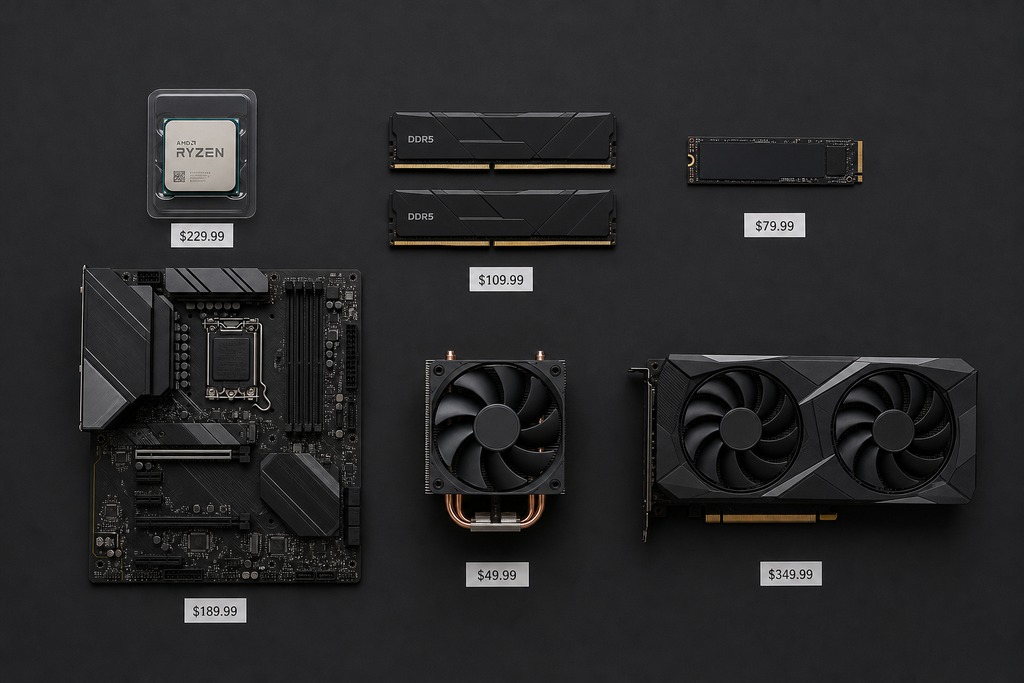
A $1,300 RX 9070 tower (or ~$1,450 with the RX 9070 XT) is the config that hits ~$12–13 per native frame. Spend on the GPU; hold the line everywhere else, because the rest of the parts buy longevity and stability, not frames.
| Component | Recommended pick | Approx. price |
|---|---|---|
| CPU | Ryzen 5 9600X / Ryzen 7 9700X | ~$250–350 |
| GPU | RX 9070 or RX 9070 XT | ~$630 / ~$760 |
| RAM | 32GB DDR5-6000 | ~$90–110 |
| Motherboard | B650 / B850 | ~$180–220 |
| Storage | 1–2TB PCIe 4.0 SSD | ~$120–140 |
| PSU | 750–850W 80+ Gold | ~$110–130 |
| Cooling + case | Air cooler + airflow case | ~$100–120 |
Totals land near ~$1,300 with the RX 9070 and ~$1,450 with the RX 9070 XT. The XT is the smarter pick for a 144Hz monitor as long as the price gap stays under roughly $175. You don't need PCIe 5.0 storage or a 360mm AIO here — neither adds a single frame at 1440p, and both push the cost-per-frame number the wrong way.
What moves the cost-per-frame number
Six variables shift the math more than any single spec. Know which way each pushes before you commit a dollar.
- Ray tracing flips the winner. With RT on, the RTX 5070 Ti's ~66 FPS beats the RX 9070 XT's ~56 in Tom's Hardware's 1440p RT suite — NVIDIA gains, AMD's raster lead shrinks. Play RT-heavy games and the value pick changes.
- Frame generation stays out of the math. DLSS 4 and FSR 4 raise the displayed FPS but not input latency or baseline responsiveness. Counting generated frames makes any card look artificially cheap.
- VRAM sets the floor. 12GB is the minimum, 16GB the target. An 8GB card sabotages its own value through texture penalties at 1440p — skip it regardless of price.
- Reused parts lower the system number. Carrying over a case, PSU, or storage strips $200–$300 off the build and drops your whole-system cost per frame accordingly.
- Prebuilts cost more per frame. A July 2026 RTX 5070 prebuilt with an i5-14400F, 16GB, and a 1TB SSD sold near $1,400 — more than a stronger DIY RX 9070 build, per PC Gamer's market tracking.
- CPU spend barely buys frames. At GPU-bound 1440p, a costlier chip adds almost nothing. Budget ~$250–350 for an X3D-class or capable mid-tier CPU and stop.
Who should NOT chase cost per frame
Cost per frame is a comparison lens, not a decision rule — and several buyers should ignore the lowest number entirely. If the cheapest per-frame card can't hit the experience you want, it's the wrong buy no matter how good the ratio looks.
- Skip the Arc B580 if you want Ultra 100+ FPS. Its ~$3.55 per frame wins on paper, but ~70 FPS means compromised settings. The low price barely moves the system total anyway.
- Skip AMD if ray tracing or DLSS is your reason to play. The value crown belongs to RDNA 4 in raster; NVIDIA takes it back the moment you turn RT on.
- Skip the flagships for 1440p. The RTX 5080 and 5090 justify themselves at 4K or in content creation, never at frames-per-dollar on a 1440p panel.
- Skip MSRP-based budgeting. Street prices run 10–30% higher; a build planned off sticker figures comes up short at checkout.
- Skip the cost-per-frame obsession if you're carrying over parts. Once a case, PSU, and storage are free, the whole-system math tilts hard toward spending the savings on the GPU.
Projected 1440p Gaming PC Cost Per Frame in 2026
Because the silicon is fixed and already benchmarked, every remaining move in 2026's cost per frame is a pricing move, not a performance one. No unreleased card is going to redraw the hierarchy this year, so where your per-frame number lands depends on a single question: does the gap between street prices and MSRP widen or close before you check out?
That gap is the entire projection. As long as it holds, your real cost per frame tracks the street column rather than the MSRP column, and the two can sit dollars apart on the same card. Should the gap narrow, the finished-build math drifts toward the MSRP tables above — the best-case figures the market has yet to deliver. Should it hold or widen, the inflated street figures are the ones that stick. The practical takeaway is a timing one: the frames per card are settled, but the price per frame isn't, so confirm current retail immediately before you commit rather than trusting a figure you priced weeks earlier.
FAQ
How much should a 1440p gaming PC cost?
The sweet spot is $1,250–$1,500 for a complete DIY tower, landing around $12–$13 per native 1440p Ultra frame. A workable budget build runs $850–$1,050 with an Arc B580 or RX 9060 XT, though you'll trade Ultra 100+ FPS for 67–75 FPS. Prices exclude a monitor, peripherals, and Windows.
Is 1440p still good in 2026?
Yes — 1440p remains the mainstream value target, the resolution where 100+ FPS at Ultra is genuinely affordable. A ~$1,300 RX 9070 build clears that bar without upscaling, while equivalent 4K performance demands far pricier flagships. For most gamers, 1440p is where the money stretches furthest.
How much does it cost to build a gaming PC in 2026?
It ranges from ~$850 for a budget 1440p tower to $2,400 or more for an enthusiast build, per the tier tables above. The mid-range at $1,250–$1,500 delivers the best cost per frame. Add roughly $150–$300 for a monitor and peripherals if you're starting from nothing.
What is the best GPU for 1440p gaming in 2026?
The RX 9070 for overall value and the RX 9070 XT for 144Hz raster, both around $5.15–$5.29 per frame at MSRP. Choose the RTX 5070 or 5070 Ti if ray tracing and DLSS matter more than raw price-to-performance. On the tightest budget, the Arc B580 or RX 9060 XT 16GB get you in the door.
References
- Tom's Hardware — GPU Hierarchy: https://www.tomshardware.com/reviews/gpu-hierarchy%2C4388.html
- Tom's Hardware — Best GPUs and current prices: https://www.tomshardware.com/reviews/best-gpus%2C4380.html
- TechSpot — Best GPUs 2025/26: https://www.techspot.com/bestof/gpu-25-26/
- PC Gamer — Prebuilt gaming PC market and RTX 5070 pricing: https://www.pcgamer.com/hardware/gaming-pcs/the-gaming-pc-market-is-a-mess-right-now-but-this-rtx-5070-rig-is-still-at-the-same-reasonable-price-its-been-at-for-months/
Sources
See our editorial policy for how sources and updates are handled.