RAM prices in 2026 are not coming back down this year. In mid-2026, a normal 32GB DDR5 kit runs roughly $350–$500 in the US. That's three to five times what it cost in mid-2025.
Every major analyst expects that level to hold or climb higher through the rest of the year. Here's the reason, and it changes your decision. This is not the usual memory boom-and-bust cycle.
Three companies make almost all the world's memory. They have pointed their factories at high-profit AI hardware. Ordinary PC RAM is being squeezed out of production on purpose.
Ignore any forecast that promised 32GB kits for $30–$125 in 2026. Many were written in 2024 and early 2025. The AI boom overtook them, so they are now out of date.
If you need memory for a machine you're using now, buy the capacity you actually need. The price drop you're waiting for is unlikely to arrive before late 2027.
What RAM Costs Right Now (Mid-2026)
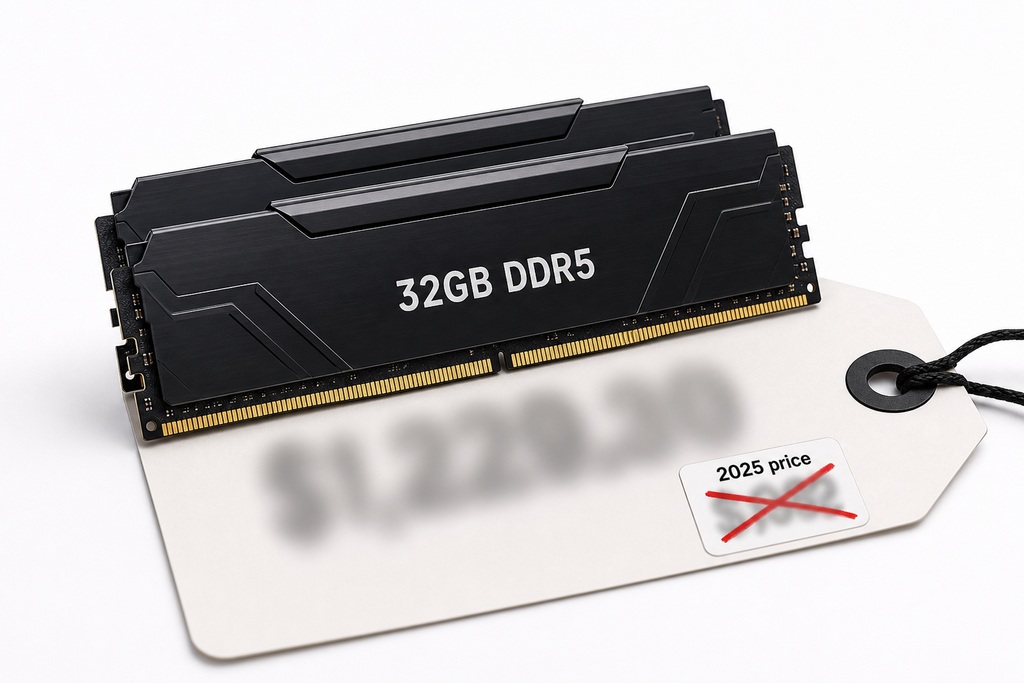
Mainstream desktop memory in mid-2026 costs three to five times its mid-2025 level. A standard 32GB DDR5 kit now lands between $350 and $500.
| Capacity & Type | Typical US Price | Note |
|---|---|---|
| 16GB DDR5 | $170–$250 | Bare minimum for a new build |
| 32GB DDR5-5600/6000 | $350–$500 | Mainstream sweet spot |
| 64GB DDR5-6000 | $700–$900 | Hit hardest by the squeeze |
| Premium 32GB low-latency DDR5 | $500–$1,000+ | Small gains, big premium |
| 32GB DDR4 | $250–$350 | Not the cheap escape it once was |
| 64GB DDR4 | $300–$450 | Legacy platforms pay up |
In early June 2026, the cheapest widely available US 32GB DDR5 kit captured in Tom's Hardware's daily RAM price tracker hit a floor of $374.97 on June 3. By late June, similar kits sat around $300–$500. The same 32GB kit sold for $80–$120 in mid-2025.
Europe looks the same. A typical 32GB DDR5-6400 kit averaged about €542 in June 2026, up 284% from €141 earlier in the tracked period, with 64GB around €799. Framework even raised DDR5 upgrade prices 50% on its DIY laptops.
Will Prices Come Down in 2026?
No meaningful decline is expected in 2026. The best realistic outcome for the rest of the year is a plateau. That means prices stop climbing but do not fall: not a return to cheap RAM.
Gartner, IDC, and TrendForce all agree. Meaningful relief is unlikely before late 2027 at the earliest. A plateau is not a drop. Even the "optimistic" forecasts leave memory far above 2024–2025 pricing.
Why RAM Got So Expensive
The surge traces to a choice, not a factory accident. The world's three memory makers changed what they produce.
- AI and datacenter demand now eat up 60–70% of all DRAM output (TrendForce). AI alone absorbs roughly 20% of global DRAM wafer capacity in 2026.
- Samsung, SK Hynix, and Micron control 95% of DRAM together. They keep output tight and fill high-profit enterprise orders first.
- Legacy DDR4 lines are being shut down, which removes the old budget option rather than saving it.
- Big cloud buyers are locking up supply on long-term contracts. Samsung told customers about Q2 2026 contract increases, and spot prices overtook contract prices on March 4, 2026: a sign inventory is running dry.
- The shift shows up in the business itself. Micron retired its consumer Crucial brand in February 2026 to focus on enterprise AI. Memory now makes up about 35% of HP's PC bill of materials, up from 15–18% a quarter earlier.
What High Bandwidth Memory Is: and Why It's Draining Your RAM
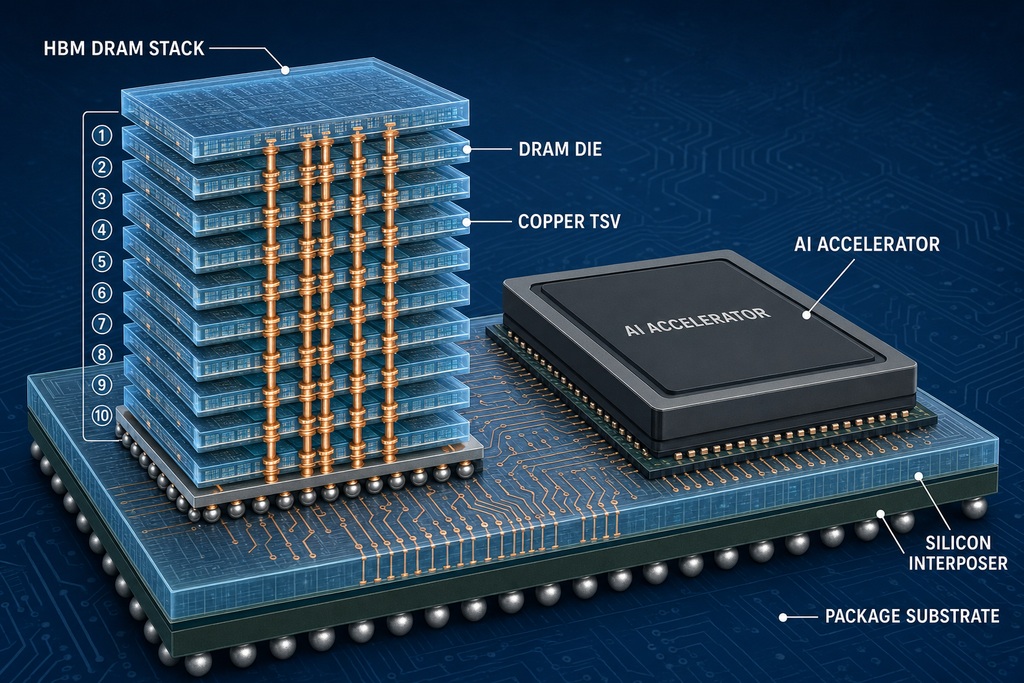
High Bandwidth Memory (HBM) is a separate, far more profitable memory product. It goes inside AI accelerators and high-end graphics cards. Makers build it by stacking 8–12 DRAM chips on top of each other and wiring them together with tiny copper links.
Per gigabyte, HBM uses 3–4 times the factory wafer capacity of standard DDR5, so it is less efficient to make. The three suppliers share one limited pool of factory space. That means every wafer sent to HBM is one taken away from the consumer RAM in your PC.
Here's the key point most explanations miss. The makers can produce ordinary memory just fine. They are choosing not to, because HBM pays more.
Why This Isn't a Normal Price Cycle
Past memory spikes followed a cycle. Suppliers made too much or too little, inventory corrected, and prices swung back on a predictable timeline.
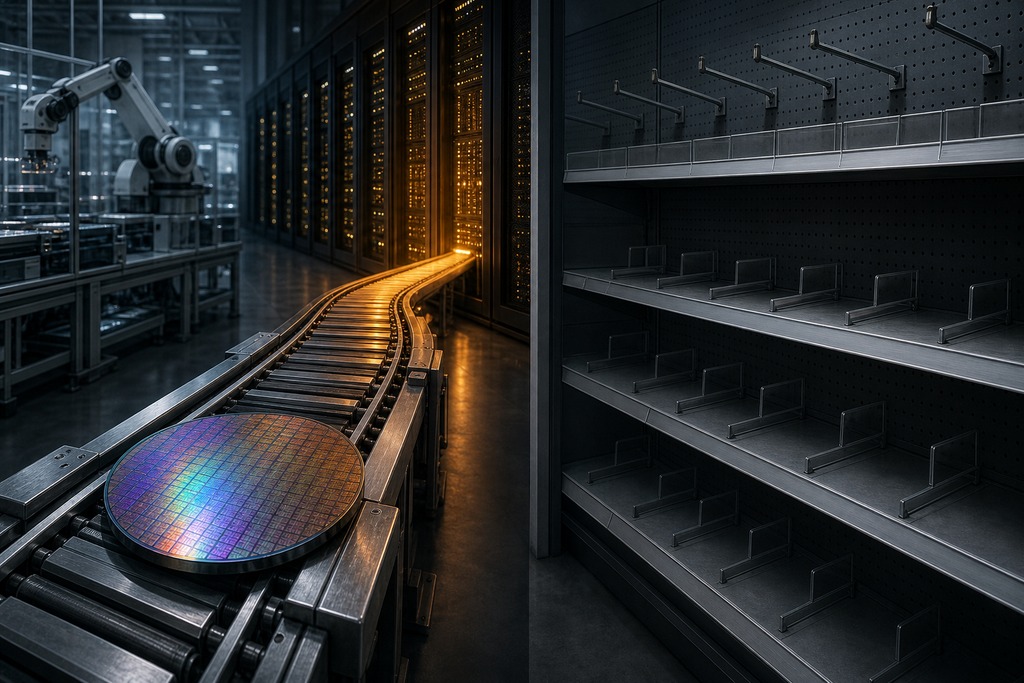
2026 is different. This is a lasting repricing tied to AI demand. The new factory capacity that SK Hynix, Samsung, and Micron are building is mostly set aside for AI and HBM, not consumer DRAM.
That's why "just wait for the crash", the instinct that worked after 2023, is likely to fail this time. Where prices have softened a little, it reflects buyers giving up at extreme prices, not new supply arriving.
What the Forecasts Say for the Rest of 2026
Analysts disagree on the exact numbers. But they agree on the direction: up or flat, never down, for the rest of the year.
| Source | What they project | Timeframe |
|---|---|---|
| Gartner | DRAM +80%, NAND +202%, combined DRAM+SSD +130% | By end of 2026 (pub. Feb 2026) |
| TrendForce | DRAM contract prices +13–18% | Q3 2026 |
| Winbond | DRAM prices nearly 4x | By June 2026 |
| Reddit claim (unverified) | +40–50% in Q3, +30% in Q4 | Q3–Q4 2026 |
| IQON | Plateau: prices stop rising, don't fall | H2 2026 |
| Consensus (Gartner/IDC/TrendForce) | No meaningful relief | Before late 2027 |
Forecast for 2026
Two individual 2026 predictions have traveled further than any analyst table, and they land at opposite ends of the range. The distance between them is worth noticing on its own. When credible estimates for the same twelve months run from "prices simply stop rising" to "prices climb several times over," the width of that gap is the real signal: it shows how little forward visibility anyone has into a market being repriced while it is still moving.
RAM Prices Expected to Rise Another 40-50% in Q3 2026, and Then 30% More in Q4 as AI Demand Outpaces Supply
This is the aggressive end of the range, and its two numbers are easy to misread. A 40–50% rise in Q3 followed by another 30% in Q4 does not total 70–80%. Percentages stacked back-to-back compound rather than add, which would push a kit close to double its mid-2026 price by the end of the year.
Is the market capable of moving that fast? It is certainly tight enough. Tom's Hardware reported that by early March 2026, smaller PC builders were being quoted DRAM prices that shifted by the hour as available supply was bid away. Still, this is the steepest single projection in circulation, not a number the major analysts share. Treat it as the worst-case bookend, not the base case.
I'm Officially Optimistic About RAM Pricing (Mid April 2026)
The most-shared optimistic take on 2026 pricing didn't come from an analyst house. It surfaced from the PC-building community, and that origin matters. It is one enthusiast's read of momentum, and it runs ahead of where the major forecasters sit. Weigh it as a single voice, not a turning point.
Making Sense of the Mixed Signals
You've probably seen two very different headlines. One warns of "40–50% in Q3, another 30% in Q4." The other says "I'm officially optimistic," a take circulating since mid-April 2026. They are not actually contradictory. They describe the same market at different sensitivities.
"Optimistic" here means the rate of increase stalls, not that RAM gets cheap. A plateau in the second half of 2026 still sits three to five times above 2024–2025 levels.
So the doom forecasts and the optimistic ones both land in the same place for your wallet: expensive, and staying that way.
Is DDR4 the Cheap Way Out?
DDR4 is no longer the budget fallback it was. Manufacturers are phasing DDR4 out instead of keeping older lines running as a cheap option. Shrinking production makes it as expensive as DDR5, sometimes pricier, with 32GB DDR4 running $250–$350.
If you're weighing an older platform to save money, compare the total cost of the board, CPU, and memory together, not just the RAM sticker. In many 2026 builds, dropping back to DDR4 saves nothing.
Should You Buy Now or Wait?
If you need memory for a system you're using today, buying now beats waiting. The cause of these prices makes a 2026 collapse unlikely.
- Don't wait for a 2026 crash: the driver is structural, so the drop may never come.
- Buy only the capacity you need; 32GB still covers most gaming and general use.
- Compare prebuilt systems against a self-build: OEMs may hold older or contracted memory.
- Consider reputable used or open-box kits if warranty isn't critical.
- Skip ultra-low-latency or very-high-frequency kits unless that small gain genuinely matters.
- Confirm your motherboard supports the modules before buying high-capacity DDR5.
- Check a price-history tool (PCPartPicker, camelcamelcamel, Newegg) rather than trusting one listing.
- Accept that there is no genuinely cheap RAM in 2026: only less-bad options.
Who Should Not Buy RAM Right Now
Not everyone should open their wallet at these prices. If you don't actually need memory for a machine you're using, speculative buying isn't justified. Prices are volatile, and you could just as easily overpay.
Buying extra capacity "to be safe" is a mistake at these rates. A 64GB kit carries a $700–$900 premium that most gamers and general users will never use.
And if you're budgeting from those older $30–$125 forecasts, you're working from wrong numbers. Reprice before you plan.
When Will RAM Get Cheaper: 2027 or 2028?
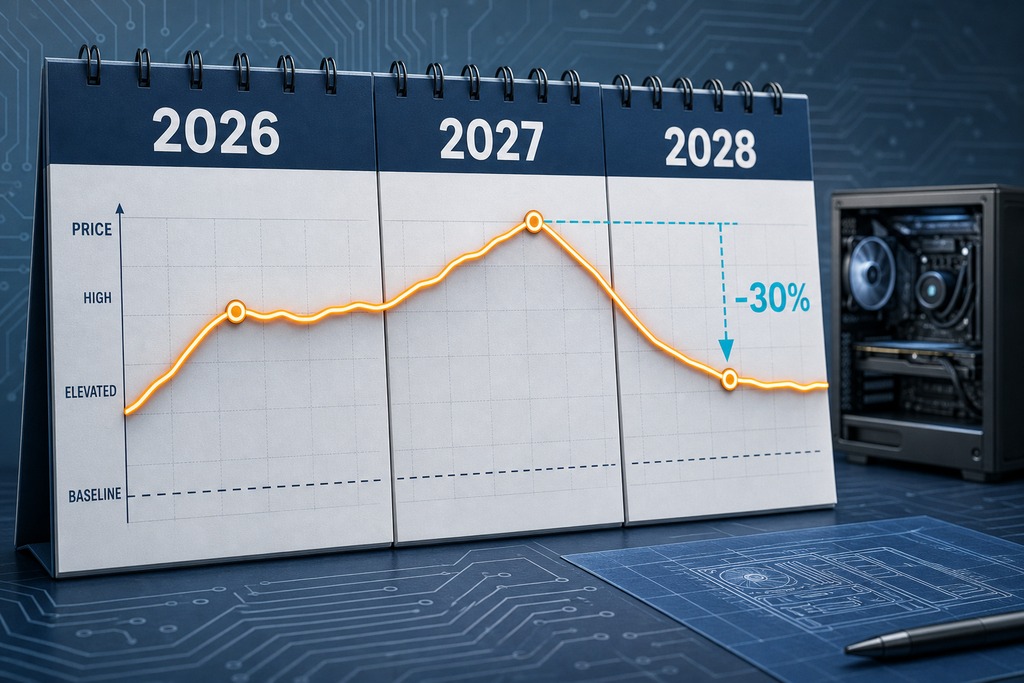
The earliest meaningful relief is late 2027. That's the shared view of Gartner, IDC, and TrendForce. Even that is a slow, multi-quarter easing tied to AI demand cooling or new capacity finally arriving: years, not weeks, away.
There is no credible signal of a fast return to 2022–2024 pricing. Gartner goes further. It projects the entry-level PC market effectively disappearing by 2028 as memory costs bite into cheap machines.
Plan for high prices through 2027. Treat any sharp 2028 drop as a hope, not a forecast.
Bottom Line
RAM is expensive and hard to get in 2026 because the AI boom's appetite for HBM and datacenter DRAM has pulled factory capacity away from consumer memory. This happened on purpose, not by accident.
Budget well above a 2024 build: roughly $350–$500 for a normal 32GB DDR5 kit in the US. Don't count on relief before late 2027. The best case this year is a plateau, not a crash.
PSU Headroom Check
Pick the parts you are actually buying. This is a sensible planning number, not a license to pay for a space heater.
If you need memory now, buy the right capacity, 32GB for most people, and verify the live price at checkout, because the exact tag shifts week to week.
FAQ
Will RAM prices come down in 2026?
No. No meaningful decline is expected this year. The best realistic case is a plateau where prices stop climbing but stay high. Gartner, IDC, and TrendForce agree relief is unlikely before late 2027.
Where to get cheap RAM in 2026?
Honestly, there is no genuinely cheap RAM in 2026: only less-bad options. Your best bets are reputable used or open-box kits, prebuilt systems using older contracted memory, and buying exactly 32GB rather than over-speccing to 64GB. Always check a price tracker before you buy.
Are RAM prices going to come down?
Not on the usual cycle timeline. This is a structural repricing driven by AI and datacenter demand, not a temporary glut that self-corrects. Prices ease only when AI demand cools or new fab capacity comes online: a gradual, multi-quarter process, not a quick swing.
Will RAM prices go down in 2028?
Some easing is possible by 2028, but no credible signal points to a return to 2022–2024 pricing. Gartner even projects the entry-level PC market effectively disappearing by 2028 as memory costs bite. Expect gradual relief at best, not a crash back to cheap RAM.
References
- Tom's Hardware — 32GB of DDR5 now costs $375 minimum as AI shortage squeezes PC building
- Windows Central — RAM crisis: when will prices drop?
- 3DCenter — Speicherkrise Preisindex Juni 2026
- TrendForce — Q2 2026 DRAM market analysis
- IDC — Global memory shortage crisis: market analysis and 2026 impact
- Gartner — 2026 DRAM and NAND price forecast (Feb 2026)
- TechTimes — RAM prices 2026: buy now or wait as Gartner forecasts 130% memory cost surge
Sources
See our editorial policy for how sources and updates are handled.